Political analyst Imtiaz Gul was among those enjoying a quiet dinner at the Marriot in Islamabad when a suicide bomber rammed a dumper truck loaded with explosives into the hotel. He escaped and recalls looking back at the raging fire: "Hell had arrived in Islamabad."
That hell had been in the making since the aftermath of 9/11 in the distant, rugged tribal terrain that marks the
border between Pakistan and Afghanistan. The US war on terror had pushed thousands of militants, Africans, Arabs, Uzbeks and Uighurs into the Federally Administered Tribal Areas (FATA) where the legendary and unquestioning hospitality of the tribals allowed these 'foreign guests' to set up strong local networks. In his recently released book The Al Qaeda Connection: Terror in Pakistan's Tribal Areas, Gul documents the complex factors that allowed militancy to grow unfettered there.
Given the fact that there are new developments almost every day in the region, what drove you to write this book at this juncture?
What compelled me to write this book were the events of March 2004 when the Pakistan army launched its operation in South Waziristan. The Pakistani government for the first time realised the beehive that was in the making in the region. Till then it had been in a state of denial about the growth of militancy on its soil.
The terrorists had been beaten out of Afghanistan and had gathered in North and South Waziristan. The entire story had been evolving since 1988 starting with the Mujahideen, then the rise of the Taliban and finally the growth of smaller terror groups inspired by the Al Qaeda.
I wanted to document the circumstances that turned the region into a zone where various conflicting foreign and domestic forces played out a battle of interests. There was NATO, the Uzbeks, the Arabs and several other elements who used the tribal territory for their own ends. Between them they created a space where non-state actors could grow and flourish.
Wasn't Pakistan aware that the area had turned into a fertile breeding ground for these militants much before the 2004 operation?
Oh yes, Pakistan was aware of the fact. But it was the first time the establishment realised that the people they
thought they controlled could bite back. We saw it again in Swat this year when the government tried to hammer a deal with the insurgents who were simply not interested in peace.
It was only then that the Pak establishment reacted by militarily fixing the situation. And this effort has been
recognised and appreciated internationally. It paid a big price for this -- nearly two million people were
displaced in the operations.
Do you think the operation launched by the Pakistan government this time around will be strong and persistent enough to reach a happy ending?
The vibes this time I think are strong enough to conclude that we are finally moving in the right direction.
Pakistan has concluded that ignorant people with tunnel vision cannot be partners in any kind of future that it
wants for itself. There is now a close alliance between the US and Pakistan.
Baitullah Mehsud is dead and two of his closest aides have been caught. This presents a big window of opportunity for us. These insurgent groups are not structured -- they are rag-tag armies of men who assembled under the TTP. They ignored their regional differences because Mehsud connected them -- through his tremendous network -- to the Al Qaeda. This connection now is in disarray.
In a chapter on who funds terror in FATA you have listed several suspects. Given the kind of games that nations and agencies played in the region and the many conspiracy theories afloat how can anyone get to the truth?
There have always been suspicions about the roles played by various nations in the area. Iran had an axe to grind so did Russia. Look at the facts and see what they indicate. Helmund in Afghanistan produces 65-70 per cent of the poppy grown in the country. Who is stationed in Helmumd?
More than 5,000 UK troops. Next door in Kandahar there are 3,000 Canadian troops. How are they all missing what is happening in Helmund -- where poppy is being used to fund terror? Between all these players they have turned Afghanistan into a narco state.
Consider abductions for ransom. I have myself collected these figures. In Peshawar, during the first week of July and the first week of August, one person was abducted every single day! Who is behind this crime?
They are criminal gangs that pretend they have the Taliban backing. Ransom money is a huge source of funding for terror. In entire remote tribal stretches there is total lawlessness presenting criminals with space to operate in the name of insurgency. We have had 42 suicide attacks in Pakistan this year. All this is the result of our earlier policies hammered out along with the CIA and the Taliban. The tribal area is open to exploitation because of the nature of the people there, the terrain and poor governance.
There was talk of distinguising between good Taliban and bad Taliban. How well could that strategy work?
Hamid Karzai has been saying the same thing for a long time: let us talk to the sane elements. Richard Holbrooke said so recently. If you look at the history of such long conflicts around the world, these dialogues become necessary for the move to peace and normalcy. It happened in the case of Arafat and it happened in the case of the African National Congress.
But the Swat deal turned out to be a disaster...
That deal was a wrong call. It was made with Maulana Sufi Muhammad the father-in-law of Maulana Fazlulla. But then he is not behind the trouble. The real trouble makers used the deal to stand behind him and pushed their own agenda of creating more disturbances in other parts of Pakistan.
But the Swat disaster turned out to be a blessing in disguise. It brought home the fact that these groups were not looking for peace. They were not even looking to implement the Sharia! It discredited the Taliban beyond repair.
For the first time it became clear that these men were not protectors of Islam and that their real agenda was
purely political and driven by outside factors.
It's clear from your book that the leaders of allied Taliban groups lie to mislead their questioners. How can you bank on anything they say to put together your research?
I never relied on a single source during my research. Besides, I am a Pashtun and I speak Pashto. I sit with these guys and talk to them, stay with them. I don't go for cursory visits or seek interpretors who will always translate words the way you want to hear them.
What is your one abiding impression of the common people of these affected tribal territories?
Once you are a guest in their homes they will protect you with their lives. They will die to save your life, they
will starve to feed you. I have stayed in homes where on the other side of the wall I knew a family was hosting a foreign insurgent. They protect both equally. I was in Wana in South Waziristan during the 2004 operations. In the night when there were gun battles all around me, the people I stayed with told me: "You just sleep. We are guarding this house." And I never once felt unsafe.
Have the events of these last few years taught the locals the need for greater caution in harbouring foreign 'guests''?
The government needs to provide these areas better governance, offer source of livelihood and security. Make them realise that they belong to the state and integrate them with the mainstream so that they accept the law of the land. The Pakistan President recently announced plans to integrate FATA politically with the rest of the country.
People who have been dealing largely with mullah, madrassa and mosque will have a fourth force to deal with -- political parties which will lobby for their own manifestos and that means an offer of alternative thought and
leadership.
Sunday, August 23, 2009


Chargesheet filed in Kargil coffin scam
New Delhi, August 22
The CBI has filed its charge sheet in the infamous 2002 “coffin scam” of the Kargil war against four persons, including two retired Army officials and one serving officer. Official sources said the charge sheet was filed on August 19 in a CBI Special Court here.
The CBI has not named the then Defence Minister George Fernandes, who had come under the scanner, following allegations that poor quality aluminium caskets were bought from USA at “exorbitant rates” after the Kargil war. Sources said Fernandes during the questioning by the CBI could not remember anything that happened during the particular period. — PTI
The CBI has filed its charge sheet in the infamous 2002 “coffin scam” of the Kargil war against four persons, including two retired Army officials and one serving officer. Official sources said the charge sheet was filed on August 19 in a CBI Special Court here.
The CBI has not named the then Defence Minister George Fernandes, who had come under the scanner, following allegations that poor quality aluminium caskets were bought from USA at “exorbitant rates” after the Kargil war. Sources said Fernandes during the questioning by the CBI could not remember anything that happened during the particular period. — PTI
Pak will get more proof on 26/11: Krishna
New Delhi, August 22
Despite Islamabad’s defiant attitude, India is no mood to relent the pressure on Pakistan to bring to book the perpetrators of the Mumbai terror attacks.
A day after India presented a fresh dossier to Islamabad on the Mumbai mayhem, External Affairs Minister SM Krishna said more evidence would be given to Pakistan to carry out its own investigations into the 26/11 incidents.
“We are in continuous touch with the government of Pakistan. It is an ongoing exercise between Pakistan and India,” Krishna told reporters here.
“So as and when we collect more evidence, we will keep sending it across to Pakistan and that’s what the foreign secretary did yesterday.”
Yesterday, Foreign Secretary Nirupama Rao had handed over to Pakistani High Commissioner Shahid Malik the latest dossier on the November 2008 terror attacks, which specifically includes “additional information” on Jamaat-ud-Dawa (JuD) chief Hafiz Saeed.
However, Pakistan has said that the latest Indian dossier pointing to the involvement of Hafiz Saeed in the Mumbai attacks did not contain anything substantial. Pakistan Foreign Minister Shah Mehmood Qureshi was quoted as saying that if India has explicit evidence regarding Saeed’s involvement in the Mumbai attacks, this should be handed over to Pakistan.
In a separate statement related to elections in Afghanistan, Krishna said: “It is gratifying to see the democratic process taking strong root in Afghanistan.”
“Despite the complex security environment and threats from terrorist groups, candidates have campaigned fearlessly and new voters registered themselves in large numbers. As a fellow developing country and a democracy, we remain strongly supportive of the election process and democratic institutions of Afghanistan,” he said.
Despite Islamabad’s defiant attitude, India is no mood to relent the pressure on Pakistan to bring to book the perpetrators of the Mumbai terror attacks.
A day after India presented a fresh dossier to Islamabad on the Mumbai mayhem, External Affairs Minister SM Krishna said more evidence would be given to Pakistan to carry out its own investigations into the 26/11 incidents.
“We are in continuous touch with the government of Pakistan. It is an ongoing exercise between Pakistan and India,” Krishna told reporters here.
“So as and when we collect more evidence, we will keep sending it across to Pakistan and that’s what the foreign secretary did yesterday.”
Yesterday, Foreign Secretary Nirupama Rao had handed over to Pakistani High Commissioner Shahid Malik the latest dossier on the November 2008 terror attacks, which specifically includes “additional information” on Jamaat-ud-Dawa (JuD) chief Hafiz Saeed.
However, Pakistan has said that the latest Indian dossier pointing to the involvement of Hafiz Saeed in the Mumbai attacks did not contain anything substantial. Pakistan Foreign Minister Shah Mehmood Qureshi was quoted as saying that if India has explicit evidence regarding Saeed’s involvement in the Mumbai attacks, this should be handed over to Pakistan.
In a separate statement related to elections in Afghanistan, Krishna said: “It is gratifying to see the democratic process taking strong root in Afghanistan.”
“Despite the complex security environment and threats from terrorist groups, candidates have campaigned fearlessly and new voters registered themselves in large numbers. As a fellow developing country and a democracy, we remain strongly supportive of the election process and democratic institutions of Afghanistan,” he said.
Nepal to check anti-India elements
Both countries okay revised treaty of trade
Ashok Tuteja
Tribune News Service
New Delhi, August 22
Even as the increasing activities of Pakistan’s ISI in the Himalayan nation has remained a cause of worry for New Delhi, Nepal has sought to reassure India that it would not allow the misuse of its territory for anti-India activities.
The two countries, meanwhile, completed negotiations and initialled the revised treaty of trade and an agreement on cooperation to control unauthorised trade from a third country. Both the trade treaty and the agreement to control unauthorised trade would be formally signed later. The two agreements have been under discussion for over two years and would be replacing agreements inked in 1991 and 1996.
India and Nepal agreed to consider steps to further facilitate cross-border arrangements in order to resolve border-related issues and to assist local populations in the border areas on both sides. The two sides also stressed on the need for strengthening the legal framework in order to counter their common cross-border security challenges.
These announcements were made in a joint statement issued by the two countries at the end of a five-day visit to India by Nepal Prime Minister Madhav Kumar Nepal.
The joint statement said the two Prime Ministers directed their Foreign Secretaries to discuss and review the 1950 Friendship Treaty and other bilateral agreements to further strengthen ties between the two countries.
To accelerate implementation of Pancheshwar Multi-purpose Project, the two Prime Ministers also directed the Joint Ministerial Commission on Water Resources and Joint Committee on Water Resources to expedite the finalisation of terms of reference for Pancheshwar Development Authority and the detailed project report of the Pancheshwar Project.
The two sides agreed that enhancing bilateral trade was a priority and that the Inter Governmental Committee (IGC) at the level of Commerce Secretaries should look into the relevant issues for promoting trade, investments and industrialisation in Nepal, expanding bilateral trade on a sustainable basis and further removing barriers to trade and investment. The two Prime Ministers directed that the IGC should meet within the next two months. To facilitate Nepal’s foreign trade, India agreed to the utilisation of its port at Vishakhapatnam for movement of transit traffic to and from Nepal.
Ashok Tuteja
Tribune News Service
New Delhi, August 22
Even as the increasing activities of Pakistan’s ISI in the Himalayan nation has remained a cause of worry for New Delhi, Nepal has sought to reassure India that it would not allow the misuse of its territory for anti-India activities.
The two countries, meanwhile, completed negotiations and initialled the revised treaty of trade and an agreement on cooperation to control unauthorised trade from a third country. Both the trade treaty and the agreement to control unauthorised trade would be formally signed later. The two agreements have been under discussion for over two years and would be replacing agreements inked in 1991 and 1996.
India and Nepal agreed to consider steps to further facilitate cross-border arrangements in order to resolve border-related issues and to assist local populations in the border areas on both sides. The two sides also stressed on the need for strengthening the legal framework in order to counter their common cross-border security challenges.
These announcements were made in a joint statement issued by the two countries at the end of a five-day visit to India by Nepal Prime Minister Madhav Kumar Nepal.
The joint statement said the two Prime Ministers directed their Foreign Secretaries to discuss and review the 1950 Friendship Treaty and other bilateral agreements to further strengthen ties between the two countries.
To accelerate implementation of Pancheshwar Multi-purpose Project, the two Prime Ministers also directed the Joint Ministerial Commission on Water Resources and Joint Committee on Water Resources to expedite the finalisation of terms of reference for Pancheshwar Development Authority and the detailed project report of the Pancheshwar Project.
The two sides agreed that enhancing bilateral trade was a priority and that the Inter Governmental Committee (IGC) at the level of Commerce Secretaries should look into the relevant issues for promoting trade, investments and industrialisation in Nepal, expanding bilateral trade on a sustainable basis and further removing barriers to trade and investment. The two Prime Ministers directed that the IGC should meet within the next two months. To facilitate Nepal’s foreign trade, India agreed to the utilisation of its port at Vishakhapatnam for movement of transit traffic to and from Nepal.
The enemy within
For the CRPF and state police personnel posted in the heart of Maoist-infested
Jharkhand, it is nothing less than a border posting; only that here the enemy
is not from another country, writes Uttam Sengupta
Jharkhand, it is nothing less than a border posting; only that here the enemy
is not from another country, writes Uttam Sengupta
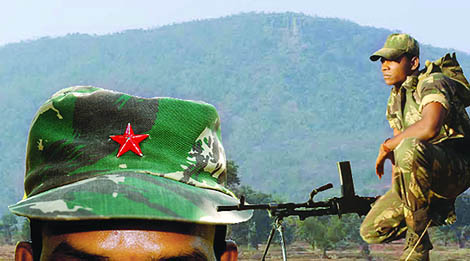
THE sarcasm was barely concealed. "Unless you visit the Jhumra hilltop, you will never be able to write about the Maoists," said the voice at the other end of the telephone. It was the Commandant of a CRPF battalion stationed at Bokaro, who was irked at media reports floated by "ill-informed" journalists. And he was daring journalists to visit the Maoist territory to see things for themselves.
The sarcasm in his voice was so stinging that the only possible response was to accept the challenge. But the Commandant was still skeptical. "It will take you three hours to reach the hilltop. So bring your sneakers, and be ready for blisters on your feet," he said before hanging up.
But luck sometimes does favour those who dare. When we reached the foothills of Jhumra, approximately 100 km from Bokaro Steel City, we were stopped by armed CRPF jawans, who had set up a camp there. Monthly ration for the jawans holding the hill, they informed, had arrived at the base camp, and a ROP had set out to sanitise the route. Unless the ROP gave a clearance, no movement would be allowed.
 The CRPF base camp at Jhumra foothills |
ROP, we learnt, was the abbreviation for "road opening party", and in this instance it comprised around 70 machine gun-wielding jawans, who had set out for the hilltop, looking for landmines, mortars, rockets and Maoists hiding in the jungle. "They improvise all the time, and you cannot take chances," explained the Deputy Commandant accompanying us. "Sometimes rockets are fired from tree-tops and sometimes these are fired from below, with the rocket launchers tucked between boulders or even below rocks," he said.
The delay, however, turned out to be a blessing because the CRPF offered to accommodate us in the supply caravan comprising a few trekkers, a jeep and two tractor-trailers. Thus, we were spared the walk up the hill.
But our relief was shortlived. As soon as the caravan began climbing, we realised there was no road, just a path strewn with stones and boulders. It was going to be a rough ride. There were steep inclines and occupants of the vehicles had to get down and give a push to jeeps being driven in the first gear. At places the path was far too narrow, and as the vehicles groaned their way up, branches of trees lashed against the occupants, lacerating cheeks of some before we all learnt to duck.
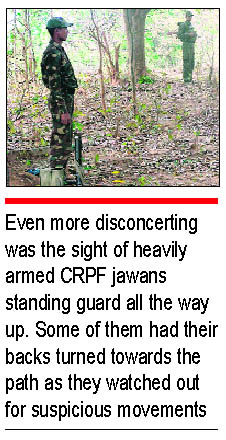
Even more disconcerting was the sight of heavily armed CRPF jawans standing guard all the way up. Some of them had their backs turned towards the path as they watched out for suspicious movement. Others watched laconically, their menacing machine guns peering out of their raincoats. These members of the ROP, we were told, would man the posts till we returned safely to the base camp.
 After the treacherous climb, the scene at the top of Jhumra turned out to be breathtaking — a flat land extending up to several hundred acres. On the fringes were dense forests and beyond could be seen the higher peaks of the hill-range. There were small villages inside the forest. Villagers living there usually survive on rabbits, birds and forest produce. They also cultivate small plots of land, rear goats, hens and even cows, especially since the CRPF had wrested control of the hilltop from the Maoists.
"They now sell their eggs and milk to us and receive a much higher price than what the Maoists used to pay them," said a CRPF officer wryly.
The Maoists apparently used the hilltop as a training camp. It was ideally placed for training their cadre in shooting, hurling grenades, using explosives and landmines etc. It was remote, and though the sound of landmines and grenades reverberated in the hills and could be heard several kilometers away and in the foothills, the hilltop was virtually inaccessible. Any movement from below could be detected from the top and foiled. The Maoists could escape at a short notice into the forests, and with the hill-range extending to four different districts in Jharkhand, they could disperse quickly and re-group for a counter-offensive. If CRPF and IB sources are to be believed, the hilltop was used to train even Pushpa Kamal Dahal, alias Prachanda, the Nepali Maoist leader who, later, became the Prime Minister of Nepal.
Getting control of this strategic hill was not an easy task though. It required several battalions of the CRPF and the armed police to wrest control of the hilltop about four years ago. And since then a contingent of the CRPF and another contingent of the Jharkhand Armed Police are permanently stationed there. There is a change of guard every two to three months. It wasn’t very difficult to see why.
The CRPF camp was almost a replica of a border area Army camp, meant to check infiltration and enemy attacks from across the border. Trenches had been dug all around the camp, and machine guns peered menacingly out of the sand bags. There were watchtowers on all corners to maintain a thorough vigil. Some of the tents in the camp had bullet holes in them, signs of Maoists’ attempts to regain control of the hilltop. Uniform trousers of a few jawans, too, had holes. "The trousers had been put on the clothesline for drying when the bullets began to fly", the Deputy Commandant explained amidst general laughter.
Next to the better laid-out CRPF camp was the camp set up by the state armed police. And the difference was stark. Compared to the resources at the disposal of the Central forces, the state policemen were clearly the poor cousins.
The force, comprising mostly of Gorkha boys barely out of their teens, appeared to be low on confidence as well as experience. The tension of watching out for an invisible and unpredictable enemy 24x7 had clearly taken a toll on the Jharkhand Armed Police personnel in Jhumra camp. They looked tense and grim as they reluctantly replied to questions posed by the visiting journalists. Their commander, a veteran Gorkha DSP, made an unconvincing attempt to claim that their morale was high.
With nothing to do except manning the bunkers, watchtowers and sleep, and nowhere to go, the youngsters looked sullen at best. The dark, cramped and leaking tent that served as living quarters provided them with just enough space to lie down on a wooden plank. I remember thinking how difficult it would be to live in a tent like that for three months.
The CRPF Deputy Commandant’s tent was right in the middle of the camp. It was a little more spacious than other tents, and by way of luxury, had a table and a few chairs. We had barely taken our seats when tea and biscuits were served. But before any one of us could take a sip, there were three deafening explosions in quick succession. We involuntarily closed our eyes and flinched. But seconds later when we recovered and stood up, there was no sign of our hosts, all of whom had grabbed their firearms and dived into the trenches inside the tent, that led to the periphery of the camp.
No further explosions followed, and sometime later, the Deputy Commandant and his men returned, trying to make light of the situation. "They just offered you a gun salute," said one of them wryly. But the edge in his voice was unmistakable. There was no time for tea, they stressed grimly. Visiting journalists had to reach the base camp safely before dusk, they said, while herding us back to the trekker.
The return journey, much of it a trek downhill, was equally adventurous. But that is another story. What I remember are the questions that swirled in my mind. Living in the cities, we are scarcely aware of the war of attrition being waged in the forests and hills of the country. What is this war all about? Who is the enemy and who are being defended by the young men on this lonely hilltop?
Whenever I read about American and British troops in Afghanistan, my thoughts return to those I met on the Jhumra hill. Their boys are fighting terror on foreign soil while our boys are fighting a war within. In both places, they are paying the price for the follies and failures of politicians and the political systems. Is there an escape at all?
A blind card
 CRPF personnel have to maintain a tight vigil whenever a caravan carries essential supplies up the Jhumra hilltop |
Maoists target police and security forces for various reasons. Since they are waging a war on the State, it is their avowed aim to weaken the State. Attacks on the security forces’ camps, police stations, outposts, armouries, etc. provide them access to weapons, ammunition and explosives. These are also used for ‘practical’ training so that the guerrillas get first hand experience of engaging conventional security forces. Finally, the attacks serve the psychological purpose of demoralising not just the security forces but also to break the resistance of people who are used to bowing before superior power. Sporadic and sudden ambushes serve the purpose of forcing the security forces into barracks or within the police stations, leaving Maoists to have a free run outside.
The collapse of the intelligence-gathering system on the ground, and the State’s failure to protect the village-level chowkidars — many of whom have been eliminated for being police informers — are further handicaps that the security forces suffer from while coping with the Maoists. The inability to distinguish between Maoists and innocent villagers tends to alienate the security forces from the people.
In Maoist strongholds, anybody can be a Maoist or a Maoist sympathiser — the milkman, the bicycle mechanic or the grocer. Unlike other law and order issues they are called upon to handle, in Maoist strongholds the security forces receive scant support from political parties or even the ruling party. Because all such political parties seem to have abandoned Maoist strongholds, leaving all ‘political’ activities to be conducted by the Maoists.
Was Partition inevitable? Desirable?
History is a great teacher. But it can also be a great tranquiliser. People, especially those societies that do not
nurture a deep historical memory, tend to forget—indeed, want to forget—the tragic and bitter episodes in their collective life. As a result, new generations have only a faint knowledge and understanding of even cataclysmic events in the past that singed the lives of their fathers and forefathers. The natural going of painful happenings into oblivion may be regarded as welcome, if those happenings had no bearing on the present. After all, how can we at all live in peace if our conscious mind is filled with memories of all the wars, holocausts, genocides and injustices that took place in the past? But when events of the past, especially the recent past, have material bearing on a country’s present and its unfolding future, forgetting is not an option. It is a sure way to court more hardships.
The bloody partition of India is one such event that Indians, Hindus and Muslims both, cannot afford to forget. Not just because it was accompanied by the killing of close to a million people in a fratricidal bloodbath, the worst in India’s millennial history. Also, not only because Partition resulted in the largest ever cross-migration in the entire human history—Hindus and Sikhs uprooted from their homes in those territories that constituted Pakistan, and Muslims from UP, Bihar, Gujarat, Maharashtra and elsewhere in India migrating, some in duress and others voluntarily, to the newly created Muslim Nation. Rather, we need to remember, examine, re-examine and learn from Partition history, principally because it has continued to determine the content and contours of the socio-political life of post-1947 India, also of the two other nations, Pakistan and Bangladesh, that were born out of undivided India. “The unexamined life,” says Socrates, “is not worth living.” He said it in the context of our individual lives. However, in the context of a nation, the unexamined life is a prescription for inviting peril.
Sadly, many educated Indians have poor knowledge of what really happened in 1947, why India won freedom but was robbed of its unity, how our motherland got vivisected, why such unspeakable barbaric acts were committed in our sacred land, what role was played by our colonial masters, and why we have not been able so far to lay the ghost of partition to rest. Some of them ask: Why exhume the past? Why re-open the Partition debate? Why not just get on with life? To know why, it is enough to just look at the number of India’s (and also Pakistan’s) domestic and neighbourhood problems that are still rooted in the tragic saga of Partition—hostile relations between India and Pakistan, far-from-friendly relations between India and Bangladesh, the unresolved Kashmir dispute, religiously inspired cross-border terrorism exported from Pakistan, the turmoil in Pakistan itself, the problems of Muslims and Hindu-Muslim relations in India, and India’s inability, because of all these challenges, to rise to its full potential.
Opening the window of debate on this epochal event in India’s recent history is Jaswant Singh’s newly released book Jinnah: India-Partition-Independence (Rupa & Co; 669 pages). It deserves to be hugely applauded because, apart from being a seminal contribution to the genre of political biography, it has provoked the political class, intelligentsia and the media to revisit 1947 and the tectonic shift it brought about in our subcontinent. It is unfortunate that Jaswant Singh’s unceremonious and unjustifiable expulsion from the BJP, within two days of release of the book, has diverted the focus of the discussion to the troubled situation within the party. However, we must recognise that far more important than the news of the day is the subject matter of the book.
Our two major national parties are uncomfortable with a thorough debate on the subject, each for its own separate reasons. The Congress does not want it because the role of many of its leaders, Jawaharlal Nehru in particular, would come under scrutiny, facts of history showing that his mistakes (in 1927-28, 1937 and 1947) pushed India towards the abyss of division. The BJP does not want it because the RSS played little organisational role in India’s freedom movement and, although rightly insisting that Bharat should remain akhand (united), it also made no contribution, either as an organisation or through its leading individuals, to the decisive political-constitutional debates on the future of Independent India that raged between 1925 (when the RSS was born) and 1947.
The Congress, with considerable help from the BJP, would like to keep the Partition debate confined to blaming Mohammed Ali Jinnah, his Muslim League, and the British. The RSS makes the additional point that partition took place because of the policy of appeasement of Muslims adopted by the Congress, Gandhiji in particular.
However, as Jaswant Singh’s scholarly book describes in great depth and breadth, the story of Partition is far more complex and multi-layered than the simplistic “Jinnah-and-British-are-to-blame” verdict. No doubt, Jinnah and his party, the Muslim League, aided and instigated by the British in violent pursuit of their poisonous and spurious Two Nation theory, played the villain’s role in India’s Partition, and it is impossible to condone his crime. But we are still left with many questions, the chief of them being: Was Partition inevitable? And was it desirable? The last question is significant because, in a curious role reversal, many Muslims in India, whose fathers and grandfathers supported the creation of a separate “Muslim Nation”, today feel that Partition was the greatest calamity to have befallen in the history of Muslims in our subcontinent. On the other side, many Hindus, who outwardly still talk of “Akhand Bharat”, privately concede that the breaking away of the Muslim-majority territories was a good thing —“we don’t want Pakistan and Bangladesh back in our fold”.
nurture a deep historical memory, tend to forget—indeed, want to forget—the tragic and bitter episodes in their collective life. As a result, new generations have only a faint knowledge and understanding of even cataclysmic events in the past that singed the lives of their fathers and forefathers. The natural going of painful happenings into oblivion may be regarded as welcome, if those happenings had no bearing on the present. After all, how can we at all live in peace if our conscious mind is filled with memories of all the wars, holocausts, genocides and injustices that took place in the past? But when events of the past, especially the recent past, have material bearing on a country’s present and its unfolding future, forgetting is not an option. It is a sure way to court more hardships.
The bloody partition of India is one such event that Indians, Hindus and Muslims both, cannot afford to forget. Not just because it was accompanied by the killing of close to a million people in a fratricidal bloodbath, the worst in India’s millennial history. Also, not only because Partition resulted in the largest ever cross-migration in the entire human history—Hindus and Sikhs uprooted from their homes in those territories that constituted Pakistan, and Muslims from UP, Bihar, Gujarat, Maharashtra and elsewhere in India migrating, some in duress and others voluntarily, to the newly created Muslim Nation. Rather, we need to remember, examine, re-examine and learn from Partition history, principally because it has continued to determine the content and contours of the socio-political life of post-1947 India, also of the two other nations, Pakistan and Bangladesh, that were born out of undivided India. “The unexamined life,” says Socrates, “is not worth living.” He said it in the context of our individual lives. However, in the context of a nation, the unexamined life is a prescription for inviting peril.
Sadly, many educated Indians have poor knowledge of what really happened in 1947, why India won freedom but was robbed of its unity, how our motherland got vivisected, why such unspeakable barbaric acts were committed in our sacred land, what role was played by our colonial masters, and why we have not been able so far to lay the ghost of partition to rest. Some of them ask: Why exhume the past? Why re-open the Partition debate? Why not just get on with life? To know why, it is enough to just look at the number of India’s (and also Pakistan’s) domestic and neighbourhood problems that are still rooted in the tragic saga of Partition—hostile relations between India and Pakistan, far-from-friendly relations between India and Bangladesh, the unresolved Kashmir dispute, religiously inspired cross-border terrorism exported from Pakistan, the turmoil in Pakistan itself, the problems of Muslims and Hindu-Muslim relations in India, and India’s inability, because of all these challenges, to rise to its full potential.
Opening the window of debate on this epochal event in India’s recent history is Jaswant Singh’s newly released book Jinnah: India-Partition-Independence (Rupa & Co; 669 pages). It deserves to be hugely applauded because, apart from being a seminal contribution to the genre of political biography, it has provoked the political class, intelligentsia and the media to revisit 1947 and the tectonic shift it brought about in our subcontinent. It is unfortunate that Jaswant Singh’s unceremonious and unjustifiable expulsion from the BJP, within two days of release of the book, has diverted the focus of the discussion to the troubled situation within the party. However, we must recognise that far more important than the news of the day is the subject matter of the book.
Our two major national parties are uncomfortable with a thorough debate on the subject, each for its own separate reasons. The Congress does not want it because the role of many of its leaders, Jawaharlal Nehru in particular, would come under scrutiny, facts of history showing that his mistakes (in 1927-28, 1937 and 1947) pushed India towards the abyss of division. The BJP does not want it because the RSS played little organisational role in India’s freedom movement and, although rightly insisting that Bharat should remain akhand (united), it also made no contribution, either as an organisation or through its leading individuals, to the decisive political-constitutional debates on the future of Independent India that raged between 1925 (when the RSS was born) and 1947.
The Congress, with considerable help from the BJP, would like to keep the Partition debate confined to blaming Mohammed Ali Jinnah, his Muslim League, and the British. The RSS makes the additional point that partition took place because of the policy of appeasement of Muslims adopted by the Congress, Gandhiji in particular.
However, as Jaswant Singh’s scholarly book describes in great depth and breadth, the story of Partition is far more complex and multi-layered than the simplistic “Jinnah-and-British-are-to-blame” verdict. No doubt, Jinnah and his party, the Muslim League, aided and instigated by the British in violent pursuit of their poisonous and spurious Two Nation theory, played the villain’s role in India’s Partition, and it is impossible to condone his crime. But we are still left with many questions, the chief of them being: Was Partition inevitable? And was it desirable? The last question is significant because, in a curious role reversal, many Muslims in India, whose fathers and grandfathers supported the creation of a separate “Muslim Nation”, today feel that Partition was the greatest calamity to have befallen in the history of Muslims in our subcontinent. On the other side, many Hindus, who outwardly still talk of “Akhand Bharat”, privately concede that the breaking away of the Muslim-majority territories was a good thing —“we don’t want Pakistan and Bangladesh back in our fold”.
Subscribe to:
Posts (Atom)